One size does not fit all in the world of antibody reactions. That is, a patient’s response to infection and vaccination differs based on when antibodies bind to and dissociate from antigens. Because each antibody reaction is unique, understanding and predicting an individual’s response is critical for ‘personalizing’ and optimizing therapeutic strategies.
Probability distributions can be used to solve this puzzle; accounting for uncertainty in data, rather than a single definitive outcome. Predictions with a level of confidence are preferable. This is achieved using probabilistic modeling, a concept that resides at the junction of medicine and math. And, that intersection is exactly where you’ll find Rayanne Luke, George Mason University assistant professor in the Department of Mathematical Sciences within the College of Science.
Luke has a strong background in the field. However, she was interested in taking one step further. She wanted to investigate, through a probability distribution modeling lens, demographic differences in antibody responses using datasets collected from severe acute respiratory syndrome coronavirus 2 (SARS-CoV-2) infection and vaccination. Further, she wanted to account for differences between those with and without pulmonary symptoms post-acute coronavirus disease of 2019 (COVID-19) infection. Luke recognized that this information could provide a useful framework for a comprehensive understanding of antibody kinetics for infectious diseases — and lead to an effective way of analyzing the protective power of natural immunity or vaccination, predict missed immune events at an individual level, and inform booster timing recommendations.
Taking that step required just the right mixture of math and science knowledge, datasets, communication skills, time, and patience. Luke saw that was possible by joining together with colleagues at UVA — Lyndsey Muehling and Glenda Canderan, using the 4-VA system. Importantly, working with Muehling and Canderan, she could access a database of measurements related to SARS-CoV-2 immune responses in different populations.
After receiving the 4-VA award, Luke brought in George Mason University graduate student Kelsey Ellis and undergraduate students James O’Hanlon and Kaitlyn Sullivan. International postdoctoral associate Prajakta Bedekar, then at the National Institute of Standards and Technology, also assisted on the project.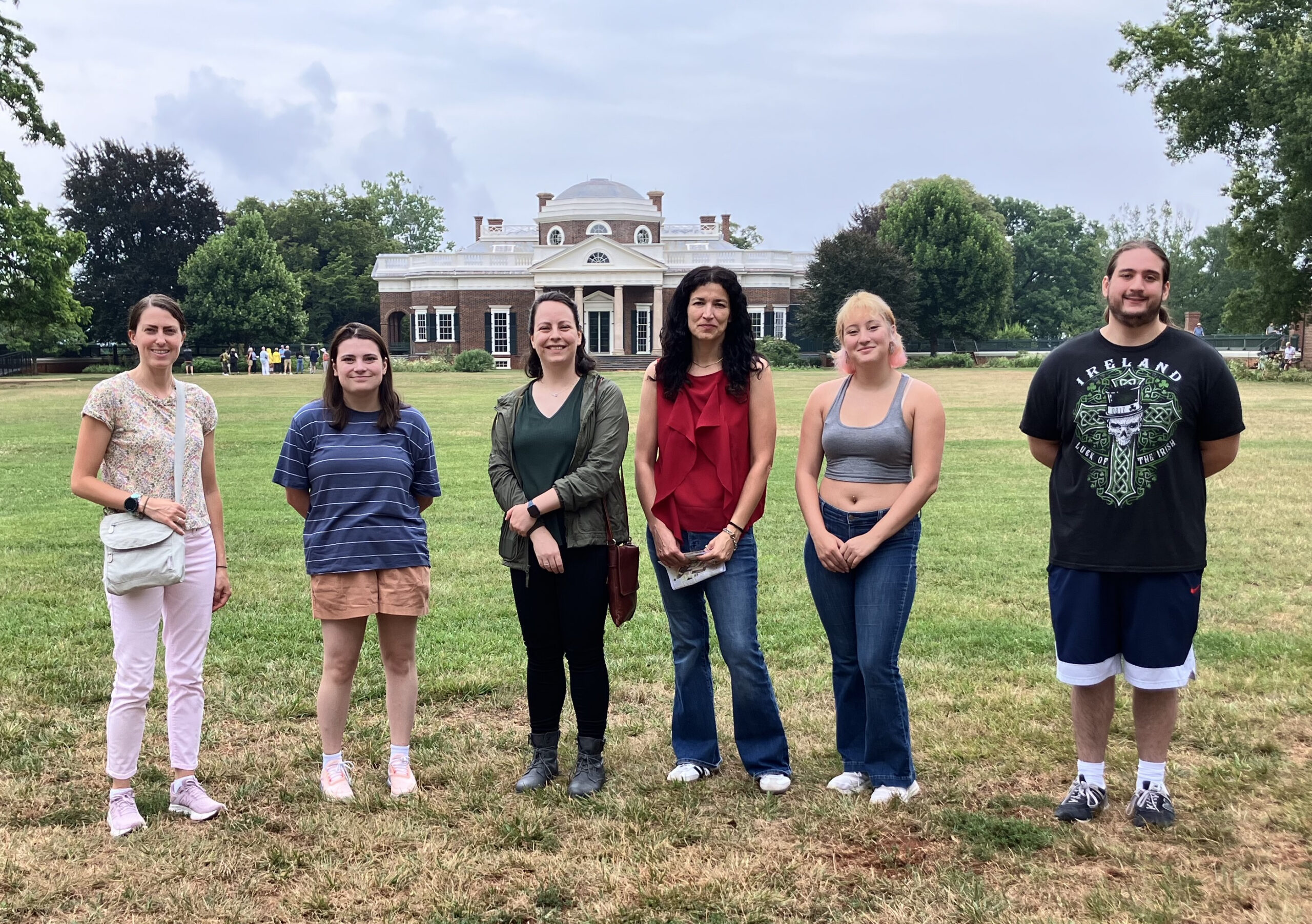
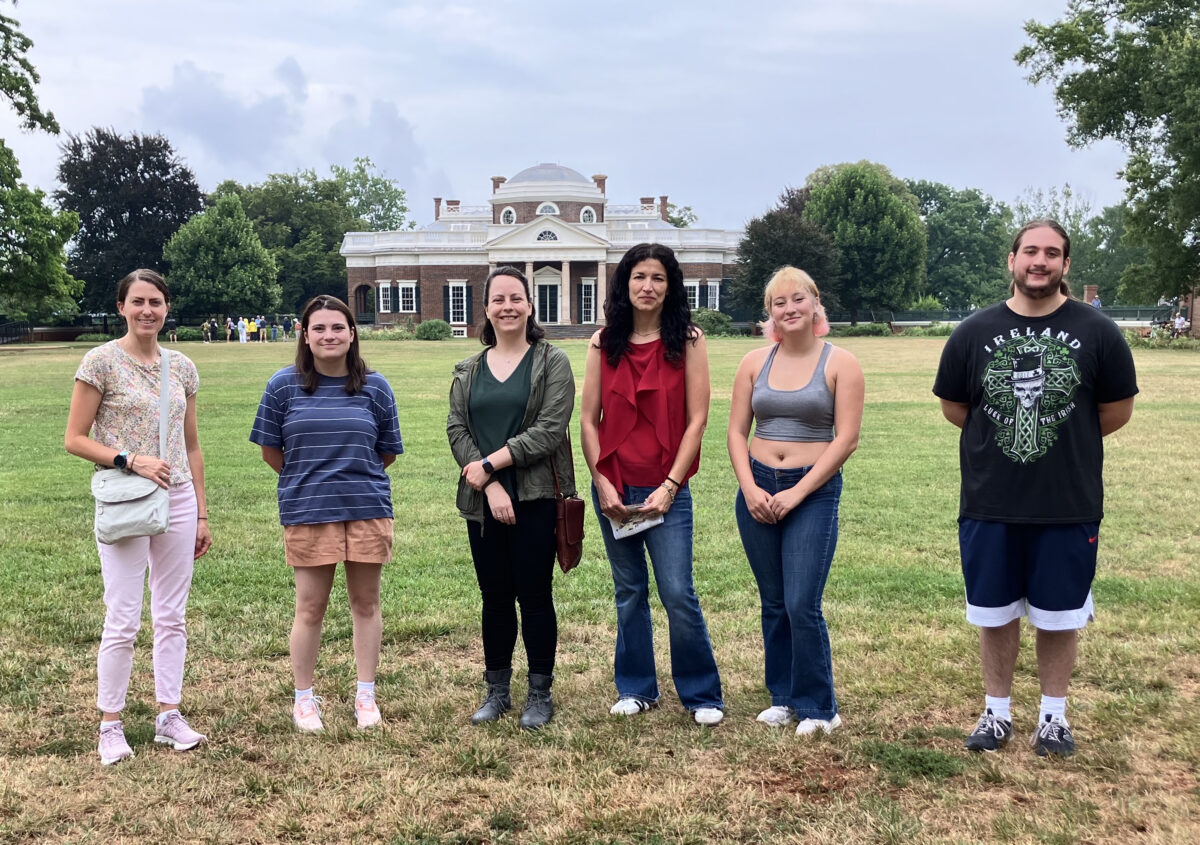
The 4-VA Team: (L to R) Rayanne Luke, Kelsey Ellis, Lyndsey Muehling, Glenda Canderan,
Kaitlyn Sullivan, and James O’Hanlon meet at UVA.
With the pieces in place, the work began. Explains Luke, “We fit time-dependent probability distribution models to the SARS-CoV-2 data to obtain distributions of longitudinal antibody response and cytokine values. We assessed differences between the modeled response curves of the groups using an overlap metric.”
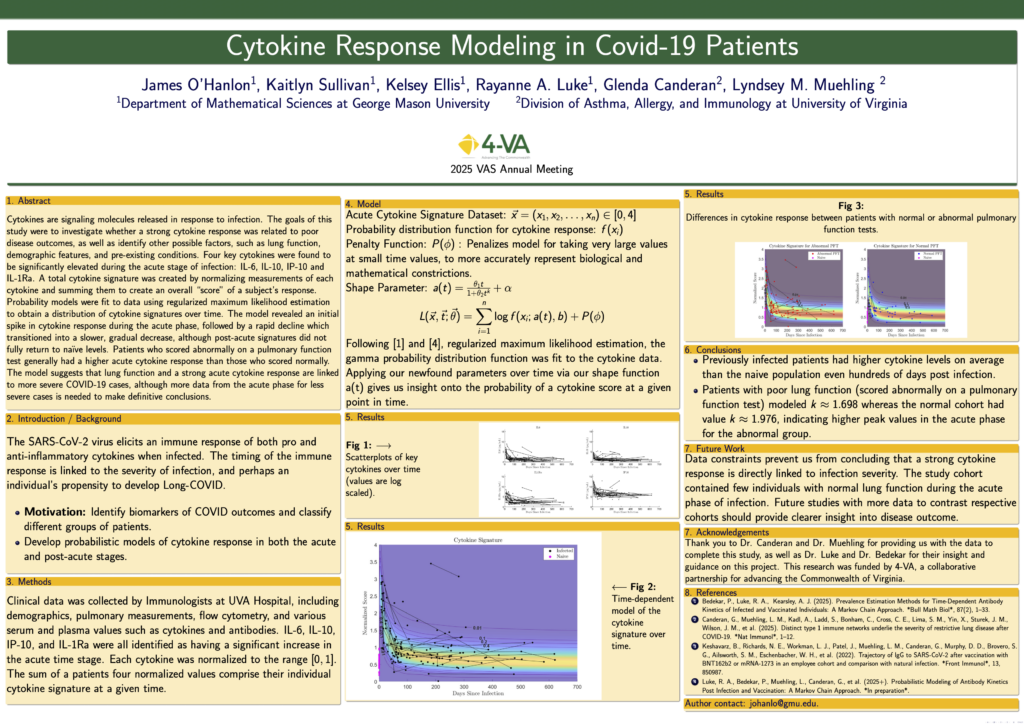
The results were striking. Explains Luke, “Our antibody models suggest significant differences between male and female populations and demonstrate deficient antibody responses of less-healthy groups such as smokers. Our cytokine models suggest that those with pulmonary symptoms post-acute infection have elevated responses over time. Further, we found that the cytokine response increases and then decays more rapidly than the antibody response.” All are important permutations for consideration in treating patients with personalized medicine.
This part of the project, driven by O’Hanlon and Sullivan, led to a recently-published paper in Spora: A Journal of Biomathematics. Additionally, O’Hanlon and Sullivan presented their work through posters at the Virginia Academy of Science Annual Meeting. Ellis presented related research at the Association for Women in Mathematics Research Symposium.
The 4-VA@Mason support partly funded a larger project in which, for the first time, Luke and colleagues designed conditional probability density models for population antibody response that simultaneously address the interplay of antibody levels; prevalence; multiple classes; time-dependence; and multiple immune events. The UVA dataset and collaboration were critical for validating this effort.
“Our work is an important step towards a comprehensive understanding of antibody kinetics for infectious diseases that could lead to an effective way to analyze the protective power of natural immunity or vaccination, predict missed immune events at an individual level, and inform booster timing recommendations,” continues Luke. “Further, this approach is fully generalizable to other diseases that exhibit waning immunity, such as influenza, RSV, and pertussis.” Further dissemination of their research is currently under review by a mathematics journal; the review is now available on arXiv, a mathematical pre-print repository.
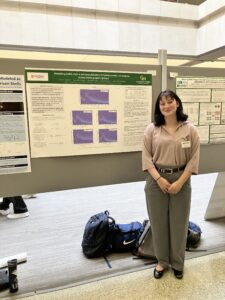
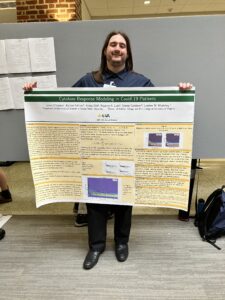
L – Sullivan
R – O’Hanlon
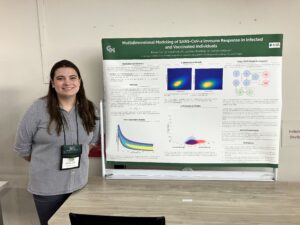
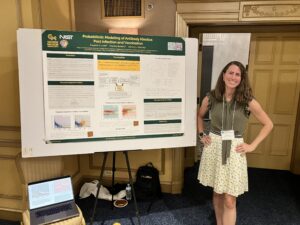
L – Ellis
R – Luke
Luke also shared findings at the National Institute for Theory and Mathematics in Biology MathBio Convergence Conference, the Joint Mathematics Meetings, and as a keynote speaker at The Society for Industrial and Applied Mathematics DMV Conference.
The team is now planning to submit a proposal jointly to the National Science Foundation Division of Mathematical Sciences and National Institutes of Health National Institute of General Medical Sciences to further the research.
Luke concludes, “The 4-VA@Mason funding served as a catalyst to bring this project up to speed. It facilitated invaluable in-person collaboration with immunologists at UVA, disseminating our findings, and importantly, training students in mathematical biology research and science communication.”