


Assistant Professor Levi Van Sant’s work in George Mason’s School of Integrative Studies focuses on environmental (in)justice surrounding food, agriculture, and land use. Previously, Van Sant has analyzed how land ownership affects the ways that racial and class dynamics of the past are reproduced in the present, focusing on the coastal United States South. More recently, however, he was interested in the ramifications of land ownership closer to home — in “the backyard” of two 4-VA partner universities, George Mason and James Madison.
Van Sant wanted to apply an existing model which suggests that higher rates of absentee and corporate-owned timberland in rural Alabama are associated with lower quality-of-life indicators such as income and education. It has also been observed that large landowners hold disproportionate political and economic power in rural communities.
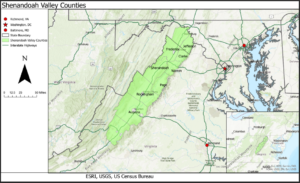
Van Sant wanted to examine land use and ownership in the Shenandoah Valley and Middlesex County in Virginia. He also saw an opportunity to provide students at both schools a chance to hone their analytical skills — as a first reading of land use and ownership records often only tell part of the story. He wanted the students to research the differences in data management between municipalities, recognize the difficulties in accessing information in rural counties, and understand how land ownership has repercussions for low-income and minoritized communities.
Van Sant applied for and received a 4-VA@Mason grant for this research and set his team to work. Jeremy Campbell, the Associate Director for Strategic Engagement at George Mason’s Institute for a Sustainable Earth; and Case Watkins, Assistant Professor in the Department of Justice Studies at James Madison agreed to volunteer their time to help coordinate the project.
The project centered on two partnerships with communities for whom patterns of land use and ownership are crucially important: small farmers in the Shenandoah Valley, which was overseen by Watkins, and the Indigenous Tribal Nations of the Middle Peninsula Region, which was facilitated by Campbell.
“We produced a large database of land ownership records for the two study regions in rural Virginia. From this database we created a series of maps that represent trends in land ownership across both study regions. We also compiled a set of maps to contextualize and present this work. The datasets and maps are significant resources for further analysis,” noted Van Sant. “This grant provided invaluable support for further developing our research methods; creating a solid dataset for on-going research; and, most importantly, building analysis and tools for future community engagement.”
Several students were involved with the project. George Mason graduate student Tyler Grant received funding for his work handling Geographic Information System analysis and data organization. Undergraduate students Yonna Angeles, Erin MacMonigle, and Jacquelyn Batchelor received funding as mapping assistants, as well as Tamar Gorgadze, who acted as a research assistant.
At JMU, three students also worked on the project — Gina Bigo analyzed land ownership trends, Madelynn Warren looked at county land use, and Ally Windham considered the historical overview and analysis.