Although algorithms can make online searches faster and easier, they can also be fraught with dangerous biases. Research has shown that image search engines can exhibit discrimination against females or people of color, and bias is also found in online searches in employment recruiting and the healthcare field.
While efforts have been made to unveil and tackle fairness and bias glitches in search and recommendation systems, two key issues have been largely overlooked: Existing research treats different types of bias in isolation, resulting in specialized methods that are difficult to generalize; and, they focus on bias in the static environment leaving the dynamic nature of the search and recommendation process unexplored.

Ziwei Zhu, Assistant Professor in George Mason University’s College of Engineering and Computing, wanted to demystify the underlying correlation of different types of bias and develop new multi-task and graph learning algorithms to support fair and unbiased searches and recommendations. Using this information, he wanted to create and release open-source software on this subject for the research community, significantly advancing trustworthiness of AI techniques. Finally, Zhu was intent on ensuring the debias system would be sustained long term.
Zhu enlisted the help of 4-VA partner Dawei Zhou in Virginia Tech’s Department of Computer Science. Together, they responded to the 4-VA call for proposals, and, “Towards Consolidated and Dynamic Debiasing for Online Search and Recommendation” was approved for funding.
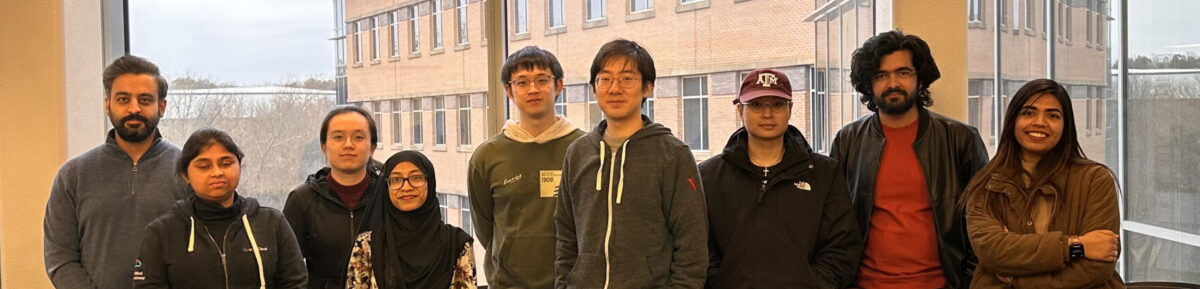
Joining the effort at George Mason was graduate student Jinhao Pan, who handled algorithm implementation and paper writing. Pan was supported by a team of Zhu’s student researchers (pictured below).The group began by developing an end-to-end adaptive local learning framework to provide recommendations to both mainstream and niche users.
Zhu sees the audience as other researchers focusing on fair and unbiased recommendations and searches, or practitioners — software developers and AI engineers — in the industry who want to improve the fairness and trust of their systems. To that end, Zhu’s group created a boosting-based framework designed to decrease a broad spectrum of biases. This framework employs a series of sub-models, each tailored for different users and item subgroups.

The results were impressive, with experiments demonstrating superior debiasing capabilities against state-of-the-art methods across four model bias types.
However, Zhu knew that their new framework for recognizing and removing biases would only be effective if implemented. To that end, the group made the algorithm implementation open source through various options — https://github.com/JP-25/end-To-end-Adaptive-Local-Leanring-TALL- and https://github.com/JP-25/CFBoost.
They also presented and published Combating Heterogeneous Model Biases in Recommendations via Boosting at the Association for Computing Machinery International Conference on Web Search and Data Mining. End-to-End Adaptive Local Learning for Alleviating Mainstream Bias in Collaborative Filtering was also presented and published at the European Conference on Information Retrieval.
In addition to the framework developed, the project increased collaboration between George Mason and Virginia Tech through coursework. The new algorithms have been integrated into materials of Mason’s undergraduate and graduate level Data Mining courses CS584 and CS484.
Zhu has used the outcome of this project as the foundation for a proposal submitted to the National Science Foundation Computer and Information Science and Engineering Core program.
Concludes Zhu, “This 4-VA grant helped me set up some computational resources so that I can conduct further research and supported travel to academic conferences to disseminate our research and learn from others. We believe this provided the groundwork for some very important first steps in this field.”