
Today, Virginia is one step closer to bridging the gap between science and policy — a critical relationship necessary to navigate a range of socio-technical issues including climate change, biodiversity loss, pandemics, and poverty. Creating this connection was the result of a yearlong research project to identify U.S. and Virginia science policy programs which engage STEM-H scientists and engineers in science policy with the end result of helping both elected and non-elected officials access technical information to assist in decision making.


This work was completed thanks to a coalition of faculty and students supported though a 4-VA@Mason grant. The team was led by KL Akerlof in George Mason’s Department of Environmental Science & Policy and Todd Schenk, Chair and Associate Professor in the Urban Affairs and Planning Program of the School of Public and International Affairs at Virginia Tech and Director of the Science, Technology & Engineering in Policy Program.
To advance best practices for professional mentorship of early career researchers and to build capacity for training researchers to engage in public policy, the team developed a database of U.S. science policy programs and conducted a case study of those in Virginia through surveys and interviews with their leaders. Akerlof and Schenk were assisted in the study by Adriana Bankston, an expert in science policy, and Mason students Kelsey Mitchell, Kate Saylor, and Aniyah Syl, and Kenneth Dewberry at Virginia Tech.
Following the yearlong collaboration, the results—along with program blogs and a listserv—has been developed and is featured on a new website created to support this emerging network of science policy programs: https://scipolprograms.org/.

The results of their research showed that the majority (57%) of U.S. science policy programs are state based. These programs include student organizations, government placements and fellowships, and academic certificates, degrees, and other training. However, it was recognized that there is only a limited ability to implement evidence-based approaches within these programs.
The team compared programmatic outcomes from Virginia’s science policy programs with those described in academic literature. Academic and professional scholarship in science communication, and public affairs suggests that curricula for engaging scientists and engineers should broadly cover communication and policy processes.
In addition, they found that training programs would benefit from evaluation models and measures, although the lack of consistent theoretical foundations and constructs across this highly multidisciplinary scholarship reduces their utility. It was concluded that a common framework, which includes shared terms and relationships, is needed to promote the transdisciplinary growth of the field.
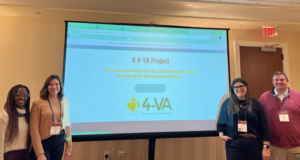
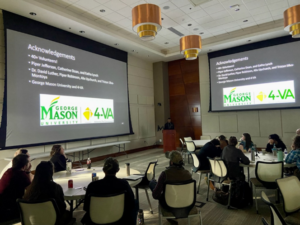
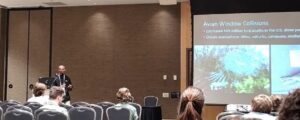
With the results of their analysis in hand, the team held a state webinar on science policy programs featuring 11 of the 13 Virginia program leaders. The project was also highlighted at a Virginia Sea Grant Symposium and was the topic of an American Geophysical Union e-lightning talk.

While the results of the study proved important, the project also provided rich opportunities to the students participating in the effort. Undergraduate student Syl and doctoral candidate Mitchell helped lead the webinar and participated as co-authors on the publications. Further, Syl co-presented at the Virginia Sea Grant Symposium. Plus, master’s student Saylor successfully defended her thesis on the Commonwealth of Virginia Engineering and Science (COVES) Policy Fellowship. She subsequently presented her results to the President of the Virginia Academy of Science, Engineering, and Medicine, Dr. James Aylor.
The first of two research articles based on the project has just been accepted with minor revisions by the journal Evidence & Policy. A second article has also been submitted for publication. They are also in conversation with the leadership of the Virginia Academy of Science, Engineering, and Medicine about the development of a new weeklong science policy program for undergraduate students from across the Commonwealth’s public universities.
Akerlof reflects on receiving the 4-VA@Mason award, “This funding supported our cross-institutional collaboration and ability to conduct baseline research and networking that have been fundamental to understanding how the landscape of science policy training programs is evolving across the United States.”


 Today, to Luther’s great delight, the results have proved far more successful than he could have ever anticipated. Tens of thousands of animal images from camera traps and audio recordings have already been collected.
 Hassan, Jordan Seidmeyer, Katie Russell, Carolian Sanabria, Adrian Em, Alix Upchurch, Piper Robinson, Tristan Silva-Montoya, and Estefany Umana spent hours creating this treasure trove of records. Emilia Roberts, a MS student in ESP, managed these undergraduate researchers.
 The project continues to gain traction. The team has created a website featuring the results of the acoustic portion of the research,
 This was achieved following 4-VA’s approval of a proposal by George Mason’s Yun Yu, an Assistant Professor in Chemistry and Biochemistry Department, for a grant entitled
  Led by Myeong Lee, Mason’s Assistant Professor of Information Science and the Director of the Community Informatics Lab, the researchers also included former College of Science faculty members Olga Gkountouna, who assisted with machine learning model development, and Ron Mahabir who provided insight on geographical data analysis. Amr Hilal of Virginia Tech helped with data analytics from a machine learning perspective.
 in their geographical area, it tends to attract more participants. In a second finding, the team implemented three advanced machine learning models to predict the success of local Meetup groups, finding that the performances of these prediction models vary across different categories and cities, with some outperforming the state-of-the-art models.
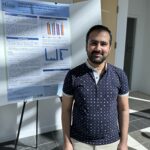 Graduate student Muhammad Umair (left), who gathered and processed fMRI and firing rate data for the research, won first place at the College of Engineering and Computing Innovation Week at Mason with a poster titled ‘Subject and Task Fingerprint using Dynamic Reconstruction from fMRI Time-series Data’.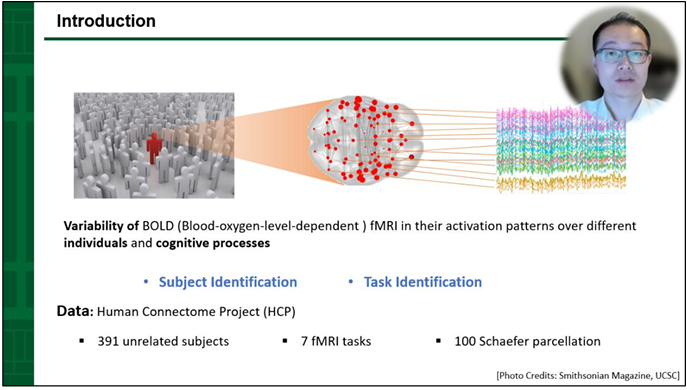

 This dilemma had been on the mind of Margaret Weiss, Associate Professor of Special Education at Mason who has long researched co-teaching and pre-service teacher preparation. She saw an acute need to develop and then test a hybrid professional learning series to prepare general and special education teachers in secondary inclusive classrooms to implement effective co-teaching practices.
 Rodgers, an Associate Professor at VCU, would be the perfect collaborator. Rogers specializes in inclusive classrooms, co-teaching, learning disabilities, single-case design methods, collaboration, and classroom observation. As VCU is a partner in the 4-VA network, Weiss was able to invite Rodgers to join her in a 4-VA proposal as a co-principal investigator, which was subsequently greenlighted by the 4-VA@Mason Advisory Board.
 To look closer at this phenomenon, Byunghwan Son in Mason’s Global Affairs Program was interested in creating an intellectual space where systematic research on contemporary Asian and Asian American studies subjects could be nurtured and fostered. To do so, he turned to a 4-VA@Mason Collaborative Research Grant for funding to build on data he had already collected between 2019-2021. His objective was to conduct additional interviews necessary to glean a more in-depth understanding of the cross-ethnic and -racial nature of K-pop. Son’s plan was to coordinate faculty at Mason and UVA to recruit and advise graduate and undergraduate students to conduct the work, providing rich research opportunities. These opportunities would include collecting, cleaning, and coding interview data of K-pop fans in North America.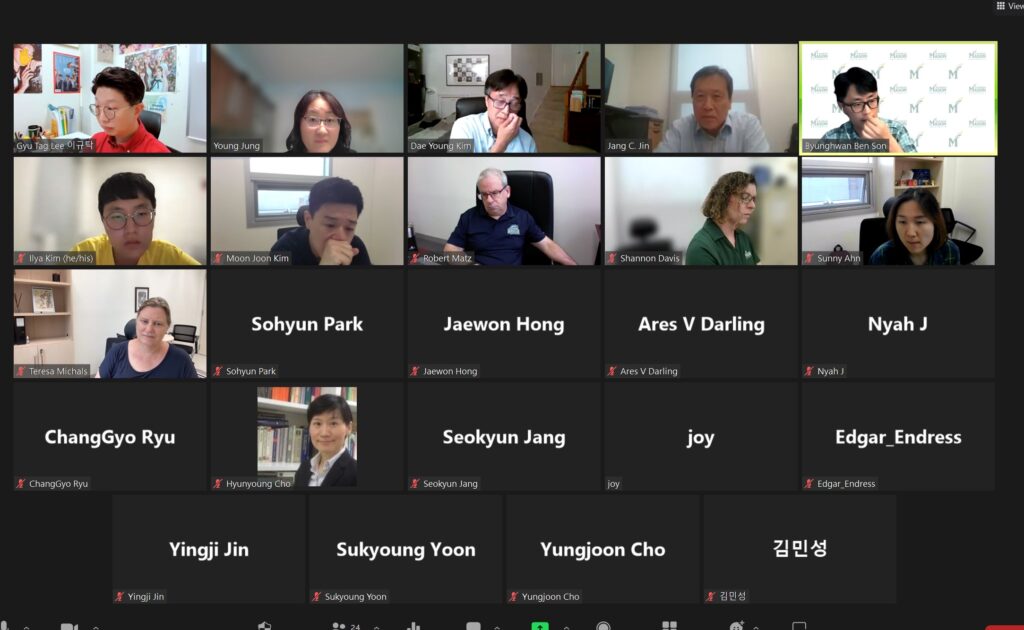

 communication center consultants:
 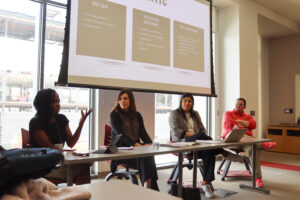 The project and results were presented at the National Association of Communication Centers (NACC) Conference last spring in Blacksburg, Va, and recently at the National Communication Association conference in National Harbor, Md. Broberg reports, “The response was really exciting. Directors from centers all across the country were grateful for the new resources to help training be more consistent and reliable nationwide.”